about
I study how to make imperfect signals from inside a model safe to use in RL. My current work puts visual-attention probes into GRPO rewards for vision-language models, with constraints that let the probe break ties but never override correctness.
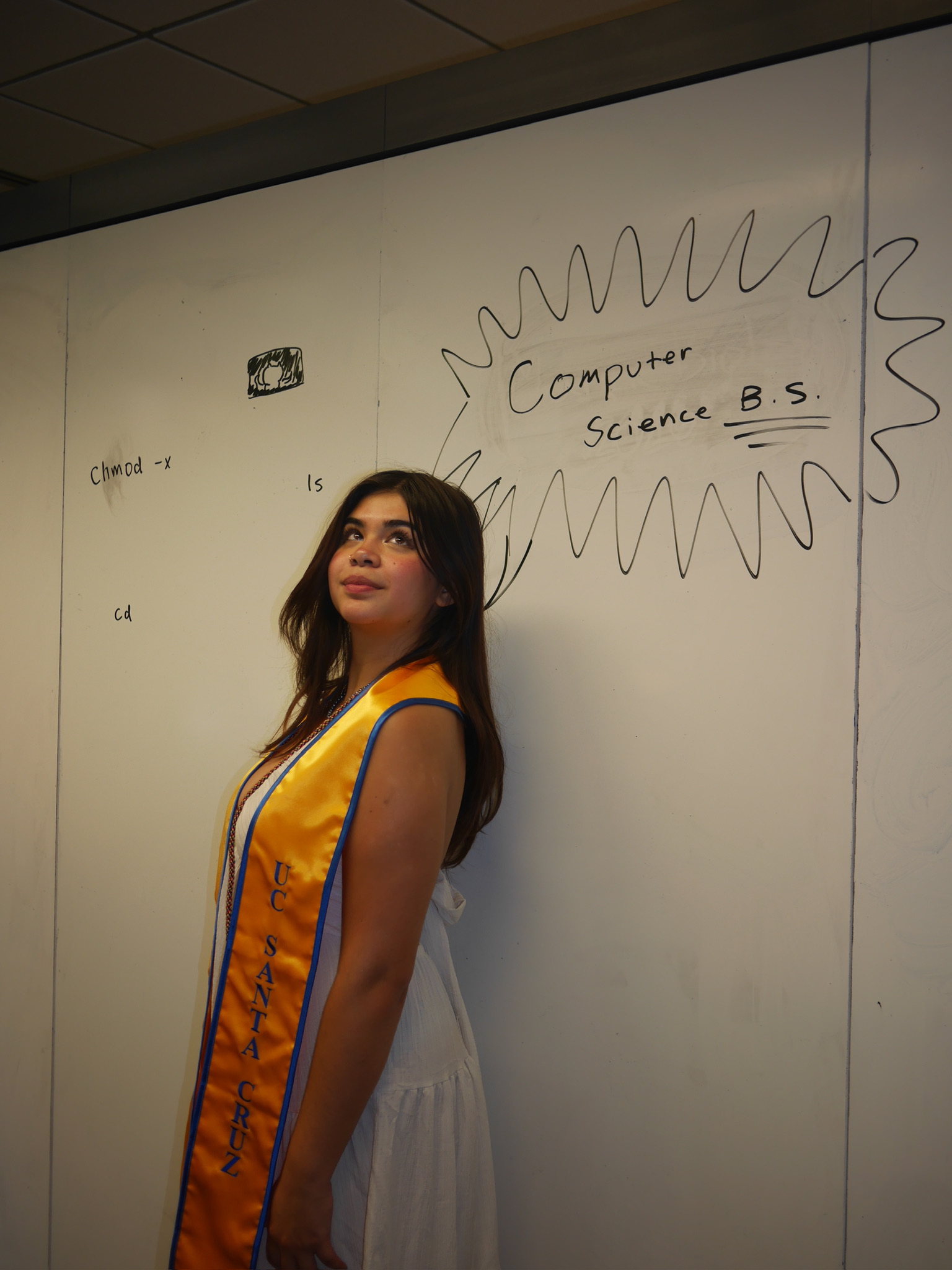
I did my B.S. in Computer Science at UC Santa Cruz (2022–2026), where I pitched and first-authored a GRPO research paper in Dr. Yuyin Zhou's lab. Before that I worked on explainable ARC-AGI reasoning at TrainLoop (YC W25) and on on-device LLM tooling at Intel. Lately I've been spending my own time on interpretability for safety: faithfulness, reward hacking, and eval awareness.
research interests
Model internals as a training signal
Using probes on attention and activations to shape RL rewards, with guarantees that an imperfect signal can't override what's actually correct.
Faithfulness and model behavior
Whether a model's stated reasoning reflects what really drove its answer, and how personas, pressure, and framing shift behaviors like reward hacking.
Grounding in multimodal reasoning
Why vision-language models drift off the image into repetition collapse, and why their execution fails even when their reasoning is right.
news
- Oct 2026Committed my first-author FT-GRPO paper to EACL 2027 after ACL Rolling Review.
- Aug 2026Submitted my first-author paper on attention probes in GRPO rewards to ACL Rolling Review.
- Jun 2026Finished my B.S. in Computer Science at UC Santa Cruz.
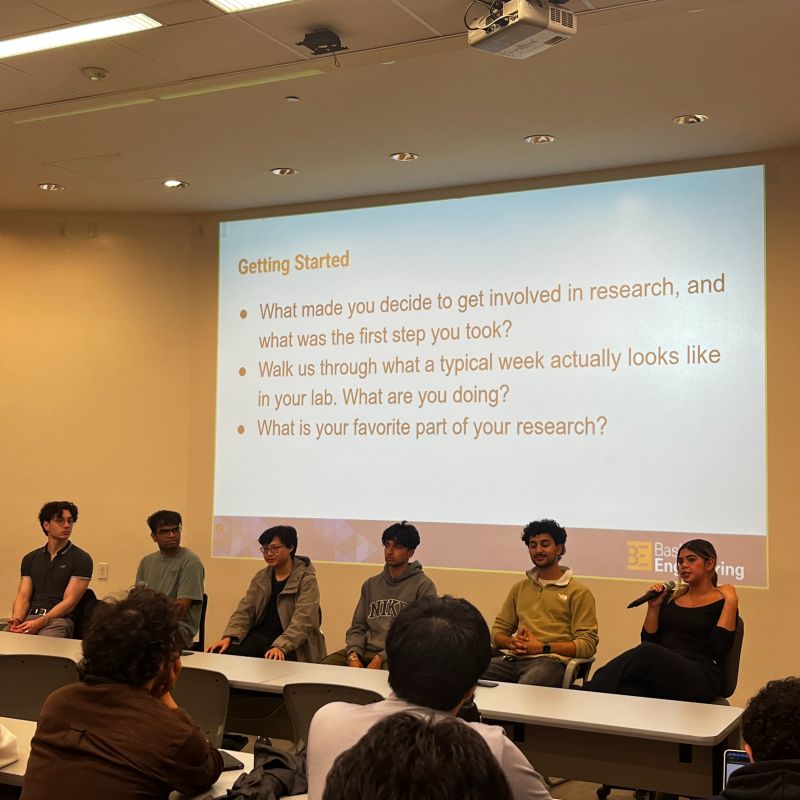
- Mar 2026Spoke on Baskin Engineering's undergraduate research panel at UCSC.
- 2025Published a TrainLoop research report on explainable ARC-AGI v2 reasoning, showing GPT-5-nano's bottleneck is visual execution, not reasoning.
- 2025BrowseIQ won AgentHacks 2025.
research
Break the Loop with Good Attention: Visual-Attention-Based Probes in GRPO Rewards to Mitigate Repetition Collapse
Committed to EACL 2027 · ACL Rolling Review, Aug 2026
Reasoning VLMs trained with GRPO can fall into repetition collapse when their attention drifts off the image. A frozen probe on visual attention (0.796 AUROC) is used only to break reward ties, never to override task correctness; we call this FT-GRPO. It also recovers a learning signal from fully tied groups, where vanilla GRPO gives no gradient at all.
A model answers the same question 8 times. Training then pushes each answer right (do more of this) or left (do less). Bar length is how hard.
Question: Read a graph of y = −6·log₄(x − 1) + a that passes through (5, −3), and find the function.
✓ right✗ wrongright answers always stay above wrong onesClick After to see what changesRight, then 1,300 words doubting the graphPlugs in (5, −3), solves, answersShort and confident, but reads (5, 3)Reads (5, −3), solves, checks onceRight after ~2,000 words and 41 “wait”sReads (5, −3), solves, verifiesReads (5, 3), then patches around itRight, after 21 “wait”sPlain GRPO only knows right or wrong. All six right answers get the same push, so the one that took ~2,000 words and 41 “wait”s is rewarded exactly as much as the 214-word one.
The "push" is GRPO's advantage. These are real answers from Qwen3-VL-8B-Thinking before RL, on questions the probe never trained on, with the frozen probe's real scores; the pushes use the paper's formulas (Eq. 3, 8, 9; α = 0.5).
View as table
Answer Result Looks at image Push before Push after Right, then 1,300 words doubting the graph ✓ right 0.35 +0.54 +0.22 Plugs in (5, −3), solves, answers ✓ right 0.70 +0.54 +0.65 Short and confident, but reads (5, 3) ✗ wrong 0.81 −1.62 −1.08 Reads (5, −3), solves, checks once ✓ right 0.80 +0.54 +0.86 Right after ~2,000 words and 41 “wait”s ✓ right 0.28 +0.54 0.00 Reads (5, −3), solves, verifies ✓ right 0.82 +0.54 +1.08 Reads (5, 3), then patches around it ✗ wrong 0.66 −1.62 −2.16 Right, after 21 “wait”s ✓ right 0.45 +0.54 +0.43 - +3.4 in-domain accuracy
- +6.3 on MathVision
- ~⅓ less repetition
- Qwen3-VL-8B, full fine-tune
ARC-AGI v2: Explainable Reasoning Traces for GPT-5-Nano; The Execution Bottleneck
TrainLoop research report, 2025
GPT-5-nano solves ARC-AGI v2 puzzles by writing illustrated instruction booklets made of IF-THEN steps. Its reasoning was fully correct on 45.5% of 33 human-annotated puzzles, compared with 0.9% raw benchmark accuracy. Execution then failed in 93.8% of those cases, so the bottleneck is visual execution, not reasoning.
- 45.5% correct reasoning
- 93.8% execution failure
- failure-mode taxonomy
experience
UC Santa Cruz
Jan 2026 – PresentFirst-Author ML Researcher · Dr. Yuyin Zhou's lab · Santa Cruz, CA
- Pitched the project in office hours, then built all of it: the Verl training setup, RL configs, data ingestion, controls, and multi-arm ablations on 8×A100 and 2×H200 (the paper's 8B runs are all on 2×H200).
- Designed the tie-only injection method and showed that simply adding the probe to the reward lets confident wrong answers outrank right ones (the tie-break was right on 16 of 21 in-domain disagreements).
TrainLoop (YC W25)
Sept 2025 – Dec 2025ML Research Intern · San Francisco, CA
- Built a 6-stage pipeline that turns multimodal puzzle-solving into auditable reasoning booklets with a crop-transform-uncrop image loop.
- Designed the annotation schema and failure-mode taxonomy that made reasoning and execution measurable separately.
Intel
May 2025 – Sept 2025ML Software Engineering Intern · Santa Clara, CA
- Built a Haystack RAG pipeline (LLaMA-3.2) that pulls CPU anomalies from large JSON system logs, plus a deterministic Python validator to catch hallucinations.
- Wrote Intel's first internal benchmarks for local model hosting on integrated GPUs (Ollama, SYCL).
ACM at UCSC
Sept 2023 – June 2024ML Researcher · Santa Cruz, CA
- Tested BERT against gradient-based Universal Trigger Token attacks and developed a new robustness measure from the results.
- Ran the attack simulations in parallel across GPU nodes with Kubernetes and PyTorch.



projects
BrowseIQ
Winner, AgentHacks 2025
An autonomous browser agent that analyzes browsing behavior with an LLM in real time and turns it into visual dashboards.
Classified
UCSC Hack Day
A red-team/blue-team privacy auditor. Tool-calling LLMs pivot through layered OSINT sources and map a person's exposed footprint on a live canvas.
100-class few-shot classification
Computer vision
About 10 images per class, handled with ConvNeXt V2, differential learning-rate unfreezing, and 30-crop test-time augmentation.
talks
Undergraduate research panel
Baskin Engineering, UC Santa Cruz · Mar 2026
Talked about my work on hallucination mitigation for medical VQA and the years of research that led to it, and gave advice to students starting out in ML research.
misc
- Outside of research, I sing a cappella.
- Favorite non-ML build: with three classmates, I wrote a game-console emulator from scratch in C++, with CPU, GPU, and memory modules that run hex programs and render playable games. [code]
work in progress
An independent interpretability project on AI safety and model behavior. It's ongoing, so I describe the question and method here, not results.
Narrative identity vs. trait prompting in reward hacking
Does telling a model it's Hades from Disney's Hercules change how it cheats on ImpossibleBench differently from telling it "you are evil"? I build persona-vector-style directions for characters and traits, probe each layer for the exploit decision, compare steering at matched norms, and use a Jacobian lens to check whether the decision is legible before the model writes anything.
- reward hacking
- persona vectors
- probes
- J-lens